
My daughter and I had the opportunity to visit The Frist Art Museum last Friday during the opening week of their new Beatrix Potter: Drawn to Nature exhibit. My goodness, what a lovely time! We met up with a fellow homeschooling family and enjoyed wandering through the positively stunning exhibits downstairs, which have since moved on, before making our way upstairs to the Beatrix Potter exhibit.
Before I go too much further, though, I want to be sure to share that I visited The Frist and planned this blog post before I learned about some of the recent issues around how The Frist has communicated their policy on booking group tours to the homeschool community. In light of that confusion, I decided to reach out to The Frist directly to ask for clarification so as to be able to share the most up to date information with you all. I was able to correspond directly with both Buddy Kite, the Media and PR Director with The Frist, as well as Anne Henderson, their Director of Education and Engagement.
Buddy Kite, their Media and PR Director, eagerly clarified that there had been an unfortunate internal miscommunication among the staff at The Frist as they were rolling out their new initiative, Homeschool Mondays, which started in March. In an effort to apologize for the miscommunication and to clarify their commitment to welcoming homeschool families to The Frist, they shared their freshly updated policy for homeschool groups. With permission, I’d like to quote directly from our correspondence so as to hopefully clear this up, once and for all. The photos of the Beatrix Potter: Drawn to Nature exhibit space that I will share later on in this post are also from this correspondence.
“There are no restrictions on homeschooling families wishing to visit the museum. Any and all families are invited to visit whenever the museum is open and guests 18 and younger are always free. Any group will continue to be welcome to request a guided tour or arrange a field trip for 10 or more guests. Here is more information about our options and registration process: https://fristartmuseum.org/tours-and-groups/
In March, we launched Homeschool Mondays—the last Monday of each month, except May, November, and December due to holidays—as a way for us to offer additional resources specifically to homeschool families. On those designated Mondays, homeschool groups are invited to visit the museum without the need to register in advance.
The goal of Homeschool Mondays is to create an enhanced experience for homeschool groups. Additional guided exhibition tours are available on these days and parents can meet with an educator to discuss museum resources and make connections between select exhibitions and curriculum. Homeschool groups also have access to Martin ArtQuest on these days when no other scheduled groups are in the space.
Since we realize there is misunderstanding, we are updating our website to add additional, detailed information about Homeschool Mondays and the group tour options. We want to better communicate our commitment to serving our homeschool population and all families who look to the Frist as a place of inspiration, education, and creativity.”
I realize that several members of the Nashville homeschool community – some of whom I know personally – were on the receiving end of some concerning communication from The Frist when trying to book tours for homeschool groups over the last several months as this new program was being enacted. Hopefully seeing this direct response from The Frist can help to reassure our community that they are working to rectify that miscommunication and would absolutely like to welcome homeschool groups to visit by booking a group tour in advance on any day that they are open. In addition, they encourage homeschool families and groups to visit on Homeschool Mondays, when they already have additional educational resources tailored to the homeschool community on hand in each exhibit.
Now, one of my favorite things about the Frist is the way they constantly rotate gallery installations. Since they don’t have any permanent exhibits, there’s almost always something new to explore every time you visit. Something I enjoy trying to do is visiting when all the spaces are full and making an entire day out of digging into each one.
While the downstairs galleries have currently rotated away from what we saw on our visit, I still need to tell you about how incredible it was to get to see the two exhibits that were there. If you have a chance to ever see the work of Jeffrey Gibson or Otobong Nkanga, the two artists who were on the main level when we visited, I highly recommend that you take the opportunity. Gibson’s Body Electric exhibit immediately pulled us in with its bold colors and geometric patterns, making it nearly impossible to miss the statements being made through the art. You can learn more about him and his work on his website.
I also appreciated the mind-blowing scale of the reverence shown in Nkanga’s exhibit, Gently Basking in Debris. Growing up in Nigeria, the exhibit explained that she would often find herself playing outside, enjoying the sheen of the mica in the soil that she was playing with on her skin. This contributed to her curiosity around our use of minerals in adornment or for beauty, and as she grew, her art became a commentary on the way we exploit the earth for personal gain, especially, perhaps, for shiny things. I found the installation thought provoking and challenging, reminding me to remain conscious about how my actions impact the earth. You can read more about her and her work here.

After sauntering through these stunning spaces downstairs, my daughter and her friend were eager to explore the ArtQuest and the Beatrix Potter exhibit upstairs. Friends, we had such a wonderful time, remembering the countless iterations of spreading a blanket in the back yard to read about Potter’s many characters and what they were getting up to together before inevitably being pulled away by our own nature explorations. Finding an exhibit that touches so closely on such cherished memories together was impossible to resit. The Frist did a wonderful job of putting together an engaging exhibit and included several things to beg for kids to interact with the space, such as these little focus doors, drawing little hands and minds into closer exploration of several locations throughout the exhibit.
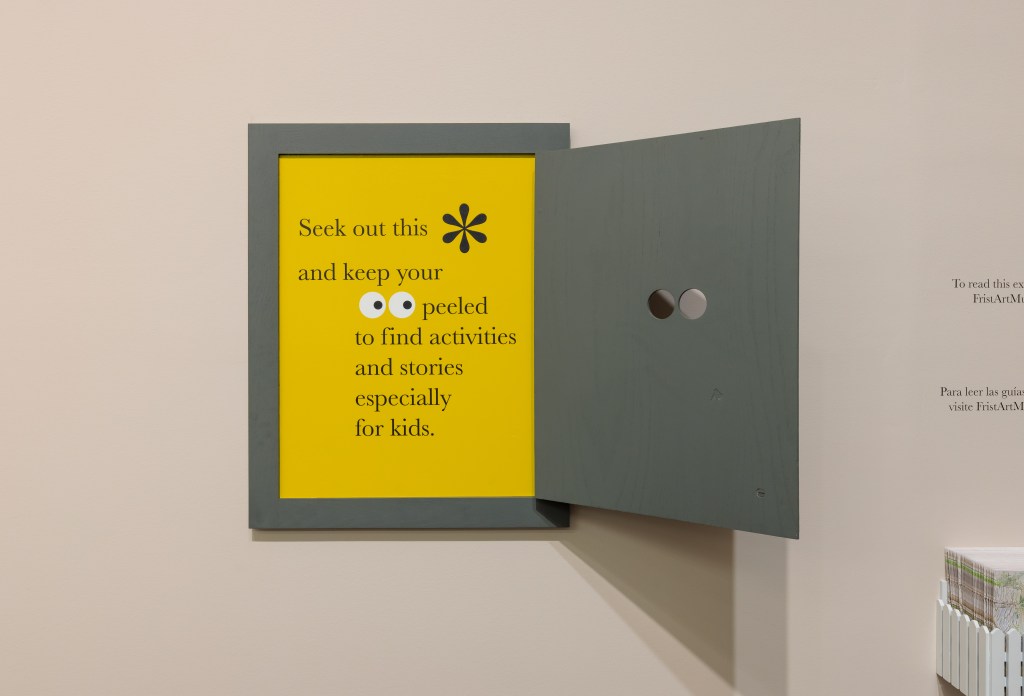
My daughter and I kept finding moments to (quietly, and with dignity, of course) squeal together about a beloved character we stumbled upon before she and her friend ultimately gravitated to the carpeted area in one of the later rooms to pile on the floor, sit in a giant flower pot, and have me read The Tale of Peter Rabbit aloud to them while they acted it out (with a few embellishments). It was such a genuinely joyful and organic moment, I almost forgot we were in an art museum.

I must say, I learned a lot and gained a deeper respect for Beatrix Potter thanks to this exhibit. There were things I already knew about her childhood, like the fact that she was also homeschooled, that she loved nature and animals, and that her parents gave her a box of paints to encourage her fascination with art. But did you know, for instance, that Beatrix Potter was an expert in mycology (I didn’t) and that she wasn’t allowed to be published as a scientist simply due to her having been a woman?
Much like so many of the female naturalists of her era (I’m thinking of women like Florence Merriam Bailey or Mary Anning), Potter was an expert in observing and learned a great deal by diving deep into a lifetime of Charlotte Mason-style nature study. Can you imagine the information we could have had in our collective scientific community had she not been shunned? Perhaps some of the things we know now about how mushrooms and trees communicate and trade nutrition could have been learned and accepted even sooner, had she been welcomed as a member of the scientific community. (More on that here.)
Regardless, I took away a lovely tidbit of ingenuity that she had come to use regularly in the form of a walking stick outfitted with a magnifying glass. What a wonderful way to be able to get up close to a specimen and truly observe it! If you’re looking for a secular resource to help you teach your children about nature journaling, I can heartily recommend this download from John Muir Laws.
And speaking of learning more, Anne Henderson, the Director of Education and Engagement at The Frist was eager to share some of the educational resources they’ve put together with you all. I’ll share those here, and you can also find them on The Frist’s website.
Be sure to scroll through the ArtQuest page to their featured videos and check out some neat ways to get inspired by nature in your art.
I hope you all are able to find a good time to go visit The Frist in the coming months and enjoy this and many other incredible exhibits!
Happy Homeschooling!
Support this website with a one-time donation
Support this website with a monthly donation
Support this website with a yearly donation
Choose an amount
Or enter a custom amount
Your contribution helps as we continue to grow this community.
Your contribution helps as we continue to grow this community.
Your contribution helps as we continue to grow this community.
DonateDonate monthlyDonate yearly
diverse. inclusive. community.
 Nashville Secular Homeschoolers